
Today at the award ceremony held at Latvijas Banka, prizes were awarded to the winners of the 24th Competition of Student Scientific Research Papers.
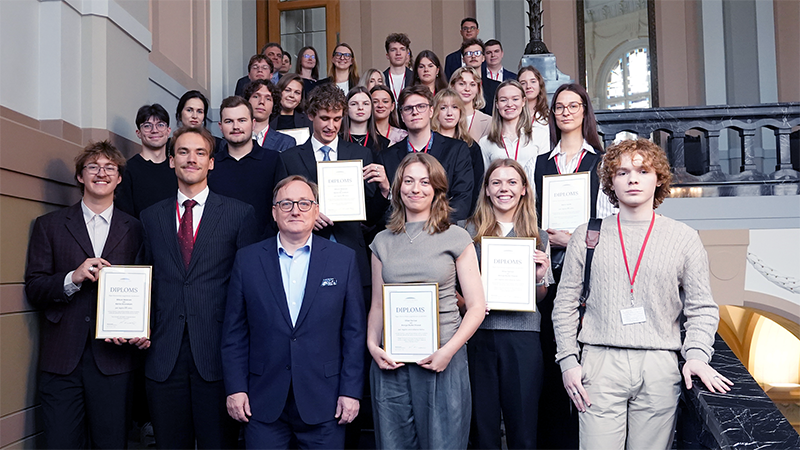
The first prize was awarded to Jiahao Zhu (University of Tartu)
Estonian Firms' Green Transition And Its Effects On Firm Performance
The content of the paper:
This work develops a framework in which green transition affects firm performance through technology upgrading and learning, while also generating temporary adjustment frictions along buyer-supplier linkages. Using Estonian administrative data for 2015-2023, this thesis measures firm-level green transition through imports of environmental goods and estimates its effects using a difference-in-differences estimator together with network-based exposure measures. The results show that green imports raise firm productivity, with the gains strengthening over time. The findings indicate that green transition is a broader process of technological and organizational adjustment, with gains emerging over time and adjustment costs extending to connected firms. This paper stands out with the richness of the utilised administrative data, impeccable methodology, extensive robustness checks, which include Placebo tests, and the extended heterogeneity analysis in the last section.
The second prize was awarded to Laura Leimane and Kārlis Kauliņš (SSE Riga)
Unstable Stability: Measuring Peg Deviations and Run Risk in Stablecoins
The content of the paper:
This thesis examines how 3 largest USD based stablecoins – namely, USD-T, USD-C and DAI maintain their peg during market turbulence. By utilising price and trading volume data from CryptoCompare, authors apply fixed-effects panel regressions, panel quantile regressions and VAR-based spillover measures. This is done to identify how stablecoins perform during market turbulences and how fast stablecoins are able to move back to value of 1 dollar. Their results from the study show that USDC has the tightest and least persistent deviations, USDT is moderately stable, and DAI exhibits larger and longer-lasting mis-pricings, especially during and after the 2022 crypto crisis. This study is not only a timely event study considering that stablecoins are all the rage these days – the authors have also developed early-warning indicators for regulators. And they even suggest liquidity management requirements to increase stablecoin financial stability – all very hot topics in the European regulatory scene.
The third prize was awarded to Igor Mohhov (Tallinn University of Technology)
Endogenous Credit Cycles And Macroeconomic Stability: An Agent-Based Approach With Adaptive Bank Learning
The content of the paper:
This paper is devoted to a financial stability topic – namely the expansion of credit cycles that may lead to the materialization of systemic risk. By developing a multi-sector agent-based model that incorporates an adaptive learning mechanism within the banking sector, the author offers an alternative to standard macroeconomic frameworks that primarily relies on exogenous shocks. The central contribution of the work lies in highlighting the importance of data selection in financial decision-making. The introduction of a filtering rule that excludes zero-debt firms from the bank’s learning process helps to mitigate distortions in risk assessment, resulting in more stable credit dynamics. The thesis also demonstrates the relevance of financial-real sector linkages, showing how credit constraints can affect firms’ hiring decisions and contribute to labour market persistence. This perspective adds to the understanding of how financial conditions may influence broader macroeconomic outcomes. Although the model is relatively compact and primarily offers theoretical insights, it reflects a substantial methodological effort, particularly given the complexity of agent-based modelling. In recognition of this contribution, the work has been awarded third prize.
The third prize was awarded to Mikus Meiers and Kārlis Birznieks (SSE Riga)
Has Growth Left Baltic Corporate Bond Investors Exposed?
The content of the paper:
The authors of this study examine how the contractual protection intensity, also known as the covenants, have increased investor protection and risk pricing in the Baltic corporate bond markets. By utilising a large-language-model, authors extract information regarding covenants from bond prospectuses. Authors demonstrate that increase in covenants does not minimize the risk premia investors demand. This study is very relevant for further diversifying the Baltic financing landscape and demonstrates that firms looking for extra funding do not need to "tie their hands" with strict rules to access capital markets. Market maturation and overall liquidity conditions matter more.
The third prize was awarded to Elerin Varek (Tallinn University of Technology)
Public Debt Sustainability and Fiscal Space in European Union Countries
The content of the paper:
This work studies fiscal sustainability and fiscal fatigue by estimating country-specific debt limits and fiscal space for European Union Member States. The empirical analysis draws on an unbalanced panel of 24 EU Member States covering annual data from 1996 to 2024, with three country groupings: all countries, high-debt countries, and low-to-mid debt countries. The assumption of homogeneous fiscal behaviour across countries at any given debt level and the linear treatment of the interest payment schedule are the main limitations of the analysis. A cubic polynomial fiscal reaction function with country fixed effects and an error structure is estimated to find fiscal fatigue thresholds. Then country-specific debt limits and fiscal space are derived under three interest rate-growth rate differential scenarios: historical, medium-term, and long-term projections. Fiscal fatigue is confirmed in the extended all-countries specification and in the high-debt subsample. The results indicate that the estimated average debt limit declines from 252 percent of GDP under historical differentials to 205 percent under long-term projections, while Denmark, Sweden and the Baltic States possess the largest fiscal buffers.
Honourable mentions:
Elīza Zariņa, Annija Rulle-Titava (Stockholm School of Economics in Riga), Ivars Kraulis, Artis Kempelis (Stockholm School of Economics in Riga), Gustavs Jānis Gauja, Krišjānis Krams (Stockholm School of Economics in Riga), Ināra Babre (University of Latvia).
Mārtiņš Kazāks, Governor of Latvijas Banka, extended a warm welcome to the participants of the event. The authors of the papers winning awards received money prizes.
In the academic year 2025/2026, Latvijas Banka organised its annual 24th Competition of Student Scientific Research Papers, inviting the participation of students from Latvia, Lithuania, and Estonia who at the time of the competition were registered as students of bachelor or master programmes of higher educational institutions accredited in the Baltic States as well as inhabitants of the Baltic States studying abroad.
48 papers were submitted to the competition this year from 13 higher educational institutions of Latvia and foreign countries (Stockholm School of Economics in Riga, University of Latvia, BA School of Business and Finance of the University of Latvia, Riga Technical University, Riga Business School of Riga Technical University, Latvia University of Life Sciences and Technologies, Rīga Stradiņš University, Latvian Academy of Culture, Aalto University (Finland), Tallinn University of Technology (Estonia), University of Tartu (Estonia), Vytautas Magnus University (Lithuania) and Technische Universität Dresden (Germany)).
More detailed information on the competition is available at: macroeconomics.lv/konkursi/latvijas-bankas-competition-student-scientific-research-papers.